
Story and photos by Alison Cooley
On a recent Thursday, the glass entryway of Alan Magee Scaife Hall—normally filled with hustle and bustle—came to an unexpected standstill when students spotted two curly-haired pups sitting at the bottom of the staircase.
Grace Washney, Class of 2029, lit up when she saw Clancy and Tigger, two therapy dogs from the Humane Animal Rescue of Pittsburgh. She admitted she’d been feeling stressed as she left her lecture, but a few minutes with the dogs eased that tension.
Yash Raka and Connor Gill, first-year medical students and coordinators of the dog therapy program, welcomed Clancy and Tigger. They escorted them and their owners to a room where students were invited to come play and pet their worries away.
“When you bring a dog into a room, the room changes,” Raka said. “You just look at the [dogs] and feel better.”
Indeed, the atmosphere in the room was different after their arrival. A calm aura seemed to envelop everyone who entered. Students and staff members sat on the floor with the dogs, petting them, chatting and laughing—filling the space with warmth and connection.
Marsha Robbins (A&S ’92; EDUC ’94G) was in the dog therapy room with her licensed dog, Sproket. Robbins is a former special education teacher who decided to launch the dog therapy program at the Humane Animal Rescue of Pittsburgh after seeing the impact dogs had on her students. She fondly remembers a five-year-old student who walked Moses, a 90-pound therapy dog. He told her, “I have never walked a dog before, and I’m really good at it!” She saw his confidence soar as he walked Moses. Robbins aims to bring the benefits of dog therapy to more students of all ages.
Scientific studies have shown the benefits of dog therapy in stressful settings, including education and health care. Robbins, who studied psychology at Pitt, explains that the benefits of human-dog interaction are rooted in science. It triggers the release of serotonin and dopamine in humans, she said, and dogs experience similar benefits when petted.
Other examples include a study published by Donna Dombek, an associate professor of education at Pitt-Bradford, and Greg Gleason, a third-grade teacher at School Street Elementary School in Bradford. Dombek brought her certified therapy dog, Ellie, into Gleason’s classroom, and they found that her presence helped reinforce students’ attention and created a more positive learning environment. In addition, a 2015 study at Azabu University in Japan found that mutual gazing between humans and dogs elevates oxytocin—the so-called "love hormone"—in both species, a bond that lead researcher Takefumi Kikusui compared to the gaze between parent and child.
Jennifer Sinclair of the Office of Student Affairs’ Wellbeing Committee is grateful to Raka and Connor Gill, who coordinate biweekly dog therapy visits at the school. Their efforts support a culture of well-being, something the committee is dedicated to fostering.
By getting involved with the School of Medicine’s dog therapy program, Raka and Gill not only help their classmates decompress, but they also see the benefits of dog therapy firsthand—something that may shape them as future physicians. Maybe one day they’ll recommend it to their own patients or to the organizations they serve. No matter where their careers take them, they’ll always remember the joy their furry friends brought to Alan Magee Scaife Hall.
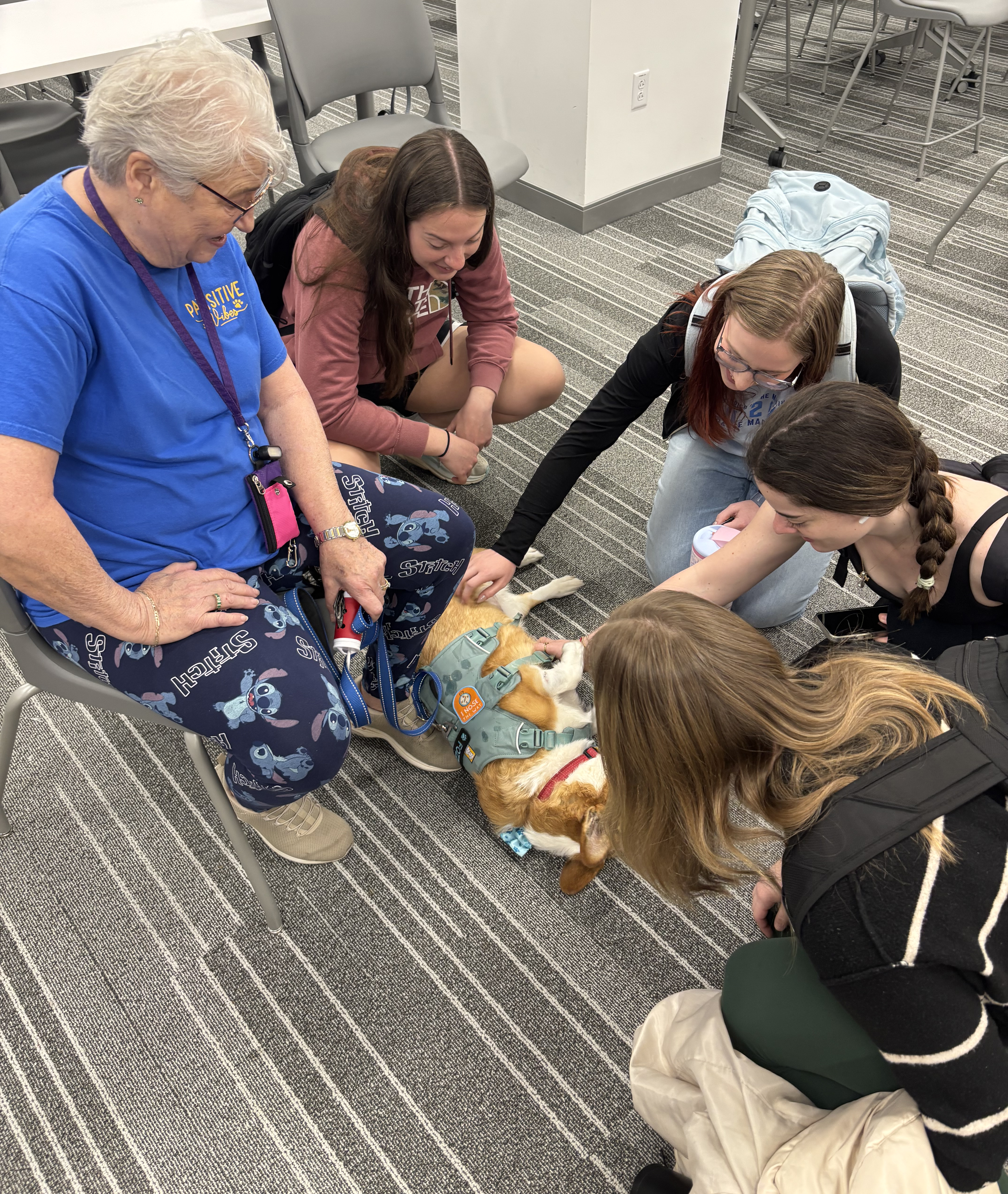
Debbie Nickle watches as students pet her therapy dog, Fozzi.

From left to right: Janice Kunz with her therapy dog, Tigger; first-year medical students Isaac Gamwo, Conner Gill (holding Clancy) and Yash Raka; Bridget O’Brien (Clancy’s owner); Marsha Robbins with her therapy dog, Sproket; and Debbie Nickle with her therapy dog, Fozzi